
Disclaimer:
All statements and opinions expressed in this article are the author’s own and do not represent the views of WIIS Italy.
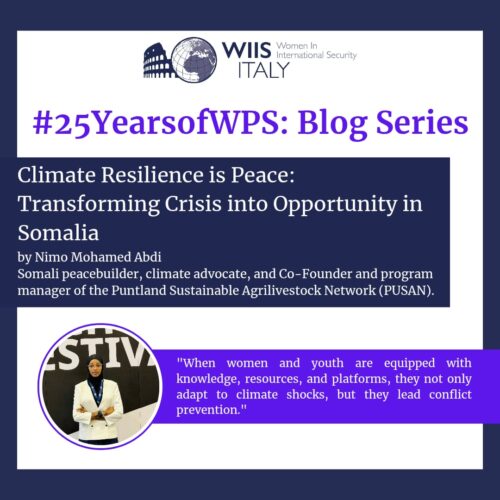
In Somalia, where decades of conflict, political instability, and climate issues such as droughts, desertification, and resource conflicts exacerbate insecurity, climate change is a threat multiplier. While women and youth are disproportionately affected by this situation, they are also emerging as leaders of climate adaptation and peacebuilding at grassroots level by restoring degraded lands, transforming farming practices, supporting community healing, and mediating resource-based conflicts. Against the backdrop of the 25th anniversary of UN Security Council Resolution 1325 on the Women, Peace and Security (WPS) agenda, it is imperative to reflect more deeply on the intersection between climate change adaptation and peacebuilding. Doing so by focusing on the case of Somalia, can not only shed light on how the escalating climate crisis is deepening poverty and displacement, as well as intensifying insecurity, particularly in rural communities that rely on natural resources for survival, but also offer a glimpse into how women-led cooperatives and youth-driven initiatives are transforming local responses to these challenges into opportunities for peace, inclusion, and resilience.
Unpacking the Climate/Gender Nexus in Somalia
Somalia is among the countries most exposed to climate change. Recurrent droughts, flash floods, and desertification are not only destroying livelihoods, but also fueling tensions over water and grazing resources. In a country where 70% of the population lives in rural areas, agriculture and pastoralism are lifelines. When rainfall fails, crops fail and livestock die, leaving families without essential resources. These environmental stresses exacerbate migration, inter-clan disputes, and even recruitment by extremist groups.
Yet, climate-related insecurity is not solely an environmental issue: it is a gendered one. In rural Somalia, women and girls are disproportionately affected by water and food shortages. They are required to travel farther to collect water, resulting in missing school, higher risks of gender-based violence, and increased difficulties in maintaining household food security. At the same time, their roles as caregivers, food producers, and community connectors position them uniquely to lead local solutions.
Women farmers driving agro-ecological change
Community-based projects in Banadir, South-West and Puntland states in Somalia, such as the Puntland Sustainable Agrilivestock Network (PUSAN), illustrate how agroforestry, climate-smart agriculture and vocational training, are contributing to environmental restoration and social cohesion. PUSAN aims to support rural communities, particularly women, in adopting sustainable farming techniques and building climate resilience. Based in Puntland, the initiative empowers women farmers through agroforestry, composting, water harvesting, and climate-smart agriculture. It provides training, tools, and cooperative networks so that women can not only grow food more sustainably, but also generate income and strengthen social cohesion.
In one of the pilot communities of the Network, women who were previously dependent on food aid began cultivating drought-resistant crops using low-cost permaculture methods. By planting trees alongside crops, they reduced soil erosion and restored degraded land. Land restoration and improved incomes reduce competition over scarce resources and foster stability at grassroot level. These changes did not occur in isolation: when women are economically empowered and connected to each other through cooperatives, they are less vulnerable to exploitation and more resilient to violence.
Youth as Green Peacebuilders
Youth make up over 70% of Somalia’s population. Yet, many young people lack access to education, employment, and safe spaces, especially in rural areas. In this vacuum, despair can easily take root, fueling migration or radicalization. It is in response to this gap that PUSAN and its community partners have launched youth-focused programmes that link climate action with peacebuilding. These programmes train young men and women in agribusiness, digital tools for farming, and environmental restoration while also offering psychosocial support to address the trauma that many youths carry from growing up amid conflict and loss.
One powerful impact story that exemplifies PUSAN’s work is that of the evolution of the Green Youth Cooperative in Baidoa, where young returnees and internally displaced youth have come together to start small climate-resilient farms. As part of their work in the cooperative youth grow indigenous crops, rebuild soil health by youth growing indigenous crops, enriching the soil through composting and mulching, and rotating crops to maintain fertility, and sell their produce in local markets. More than income, this work gives them identity, purpose, and a sense of belonging. Several youths are now trainers and mentors to others. In 2024, through PUSAN’s leadership, Somalia’s first-ever Local Conference of Youth (LCOY) was successfully launched, gathering over 100 young delegates from across the country. This milestone event provided a platform for youth to express their climate priorities and participate in national dialogue. The outcome was the creation of Somalia’s first National Youth Statement on Climate Action, a historic document that highlights the intersection of climate, peace, and security and calls for inclusive youth participation in decision-making. This statement, developed by youth for youth, includes actionable recommendations across seven key areas, from food systems to climate health and renewable energy. The LCOY process not only united Somali youth around a shared vision for resilience but also amplified their role as peacebuilders and policy influencers in both local and national climate arenas.
Bridging WPS and Climate: Pushing the agenda’s limits
The WPS agenda has achieved remarkable milestones in promoting women’s participation in peace processes and protection from violence. However, to remain relevant in contexts like Somalia, it must evolve to ensure women can serve as agents of change in tackling emerging threats, particularly climate change. A greater understanding of the inherent connection between climate resilience and peacebuilding is imperative. When women and youth are equipped with knowledge, resources, and platforms, they not only adapt to climate shocks, but they lead conflict prevention. Yet, these contributions are rarely recognized in national policies or international funding. Women-led climate action is often underfunded, and rural youth are sidelined in peace negotiations. This gap must be closed if the WPS agenda is to deliver on its promise of inclusive, sustainable peace.
Lessons and Recommendations
The Somali context highlights critical pathways for strengthening the WPS agenda in face of the climate crisis. Integrating climate resilience into WPS programming is essential because it enables women to actively lead and implement initiatives in climate-smart agriculture, renewable energy, and environmental management, while also strengthening their capacity to influence decision-making and drive sustainable change in their communities. At the same time, investment in rural women and youth as peacebuilders is fundamental, recognizing their role not merely as beneficiaries but as active agents holding their communities together. It is also imperative to acknowledge that effective peacebuilding must also incorporate psychosocial support, as trauma functions both as a barrier to and driver of conflict, making mental health interventions a central component to factor in. Moreover, policy development should be informed by grassroots data, with local case studies and community-generated knowledge guiding national climate and peace policies. Finally, cross-sector collaboration among peace actors, environmental specialists, gender experts, and local governance structures is equally vital to maximize impact.
In Somalia, climate change constitutes an immediate threat. Yet, within this crisis lies an opportunity to reimagine peacebuilding from the ground up. Women who once had no land now lead cooperatives that sustain families and mitigate conflict while youth who once had no jobs now manage sustainable farms and mentor their peers. The leadership, resilience, and innovation demonstrated by these groups are not just inspiring, but essential for building sustainable, inclusive pathways to peace.
Author Bio: Nimo Mohamed Abdi is a Somali peacebuilder, climate advocate, and Co-Founder and program manager of the Puntland Sustainable Agrilivestock Network (PUSAN). She is an alumna of Young African Leaders Initiative (YALI) and program manager of the YALI East Somali Chapter. She leads efforts focused on climate-smart agriculture, women’s empowerment, and youth employment in rural Somalia.
Commenti recenti