
Disclaimer: All statements and opinions expressed in this article are the author’s own and do not represent the views of WIIS Italy.
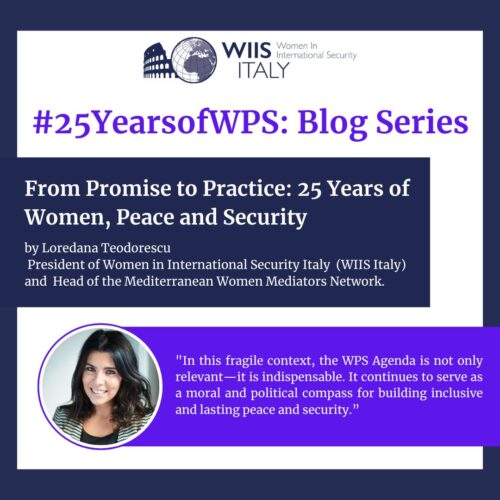
Twenty-five years ago, the United Nations Security Council adopted Resolution 1325—an historic milestone that redefined peace and security through a gender lens. For the first time, the international community clearly recognised this crucial role of women in conflict prevention, resolution, peace negotiations, peace-building, peacekeeping, humanitarian response, and post-conflict reconstruction
A quarter of a century later, the Women, Peace and Security (WPS) Agenda remains both visionary and unfinished. The promise of 1325 has inspired a global framework for gender equality in peace and security policy. Yet, its implementation is still fragmented and while the normative framework has expanded, practice still lags far behind.
An Unfulfilled Promise in a Fractured World
Since 2000, ten Security Council resolutions have enriched the WPS architecture, and more than one hundred countries have adopted National Action Plans. The Agenda has shaped the policies of the UN, EU, OSCE, NATO, embedding gender perspectives into peacekeeping, mediation and post-conflict recovery.
But despite this progress, reality tells another story. Women remain vastly underrepresented in peace processes and decision-making. In 2024, for instance, they made up only 7 percent of negotiators worldwide and just 14 percent of mediators. Moreover, their presence at the table does not necessary mean they have influence too.
At the same time, the geopolitical landscape has grown increasingly volatile: conflicts are multiplying and have reached their highest number since the end of World War II, while multilateralism weakens and militarization overshadows diplomacy and mediation. Shrinking civic spaces and backlash against gender equality further narrow the room for dialogue and challenges women’s participation. In this fragile context, the WPS Agenda is not only relevant—it is indispensable. It offers a moral and political compass reminding us that peace and equality are inseparable.
The Challenge of Participation
Participation was the beating heart of Resolution 1325, yet it remains its weakest pillar. The gap between principle and practice is not simply about numbers—it is about power, access, and recognition. Women’s inclusion transforms peace processes when it reshapes agendas and priorities. It is also well known that when women participate meaningfully, peace agreements are 35 percent more likely to last at least 15 years. Women bring perspectives rooted in justice, inclusion and social cohesion—dimensions often absent from traditional, power-sharing negotiations. But too often, institutional barriers and entrenched gender norms still exclude them. Funding for women’s organisations remains chronically low, and peace processes continue to privilege armed actors over civil society.
Closing this gap requires not just political will, but structural change. It means dismantling the systems that still treat women as an afterthought rather than as architects of peace.
Women Mediators: Architects of Peace
Despite limited space at the formal table, countless women act daily as mediators, bridge-builders, and community leaders in conflict and post-conflict zones. Their often unseen work forms the connective tissue of peace, as illustrated by the experiences of members of the Mediterranean Women Mediators Network (MWMN)—an initiative launched by the Italian Ministry of Foreign Affairs, together with IAI and WIIS Italy.
In Libya, Rida Altubuly and Hajer Sharief have fostered civic education and youth engagement through Together We Build It, reframing peacebuilding as a shared civic duty. In Lebanon, Lea Baroudi of March Lebanon works across sectarian divides, helping young people leave cycles of violence. In Cyprus, Magda Zenon sustains bi-communal dialogues between communities separated for decades.
These are examples of “peace by doing”—practical, local and persistent efforts that open dialogue long before formal negotiations begin, and maintain communication when diplomacy falters. Mediation here is considered as human connection, in a holistic way which goes beyond formal tables.
Networks as strategic actors
If individual mediators are the silent architects of peace, their networks are its foundations. Over the past decade, regional and national networks of women mediators have become critical for advancing the WPS Agenda.
From FemWise-Africa to the Nordic Women Mediators, the Women Mediators Across the Commonwealth to the MWMN—these collectives have built bridges between grassroots action and high-level diplomacy. In 2019, they came together to form the Global Alliance of Regional Women Mediator Networks, amplifying their collective voice.
The MWMN, launched by Italy in 2017 during its term on the UN Security Council, exemplifies this transformative model. With local “antennas” in Turkey, Cyprus and the Western Balkans, and local initiatives across Lebanon, Libya and Syria, it creates safe spaces for dialogue and peer learning. It connects women across borders, fostering trust and mutual recognition, and ensuring that local context-specific insights inform international policymaking.
Networks like the MWMN do more than support women—they redefine what effective mediation looks like. They build capacity, mentor new generations, amplify visibility, and advocate for accountability. They also establishing secure spaces for connection, knowledge exchange, and access provision, and facilitate connections across local, regional, and global levels while serving as a bridge between them. By doing so, they demonstrate that peace is collective, and that inclusion strengthens diplomacy, and they contribute to the implementation of the Agenda.
From Commitments to Collective Accountability
Resolution 1325 was never meant to be symbolic. It was a call to action—one that requires shared responsibility and sustained political commitment. Yet, progress depends on more than declarations.
Turning promise into practice requires genuine political leadership to turn commitments into concrete action, and strategic partnerships that break down the silos between peace, security, climate, and development agendas. It also depends on sustained funding and institutional support for women-led organizations and mediation networks, whose work is often at the heart of community resilience.
Equally essential is ensuring that women’s contributions are both recognized and valued—whether they occur in grassroots initiatives, informal peace processes, or at global decision-making tables. Implementation must be context-driven, rooted in local realities rather than imposed from above. Above all, progress requires accountability: through rigorous monitoring, reliable data, and genuine transparency. Only by meeting these conditions can the vision of Resolution 1325 move beyond rhetoric to become a lived reality.
The WPS Agenda must be treated not as a niche, but as a central political commitment shaping how we build peace and security.
An Agenda Worth Defending
The Twenty-five years anniversary since the adoption of Resolution 1325 shows how far we’ve come, and how far we still must go.
In today’s fractured world—where conflicts are increasingly complex, disinformation fuels division, and trust in institutions erodes—the principles of the WPS Agenda are more vital than ever. To defend 1325 is to defend the very possibility of peace based on inclusion, dialogue and cooperation.
Indeed, while today’s global context presents new and complex challenges, the WPS Agenda continues to serve as a moral and political compass for building inclusive and lasting peace and security. It is a tool which can and should be further leveraged: implementing it now means reaffirming multilateralism, diplomacy and mediation over militarisation, conflict prevention over crisis management—all while placing women at the centre of peace efforts.
As we face multiple, interconnected crises, we must redefine the frameworks guiding our collective responses. Women mediators and their networks working quietly across the globe remind us that peace is not built in conference rooms alone. It is built every day—through trust, empathy, and persistence. As we mark the 25th anniversary of Resolution 1325, the message is clear: if we are serious about achieving peace and security, we cannot exclude women, their perspectives and their skills. The Agenda show us the way.
The time to move from commitment to action is now. If not now—when?
Author Bio: Loredana Teodorescu is the President of Women in International Security Italy (WIIS Italy) and the Head of the Mediterranean Women Mediators Network. Additionally, she is the Head of European and International Affairs of Istituto Luigi Sturzo and Senior Fellow at Istituto Affari Internazionali. She is an expert in the Women, Peace and Security Agenda, peace mediation, and EU policies and governance, in particular in the fields of migration and foreign policy.
Commenti recenti